
CMMC starts outside IT. Free webinar June 30 @ 12PM ET. Register Now →

DFARS 252.240-7997 and FAR 52.240-93 Contract Clauses

Ensuring Compliance and Security for Defense Contractors

  • The DoD requires that all contractors handling FCI or CUI meet CMMC requirements before being awarded contracts.
  • Failure to comply could result in losing eligibility for DoD contracts, significantly impacting a company’s revenue and growth opportunities.
  • Requirements vary from business to business and are complex.
  • Alluvionic specializes in guiding defense contractors through the entire CMMC process, ensuring compliance while minimizing disruptions to business operations.
  • Alluvionic simplifies CMMC certification with a structured, step-by-step process designed to help contractors at any stage of their compliance journey.
This field is for validation purposes and should be left unchanged.

Explained for Small Defense Contractors

Contracts are starting to show new cybersecurity clause numbers, including DFARS 252.240-7997 and FAR 52.240-93. Many small and mid-sized government contractors are seeing these for the first time inside proposals, mods, and flowdowns. Search results often lag behind what is appearing in real contracts, which creates delays, second-guessing, and avoidable compliance risk.

Alluvionic helps defense contractors keep momentum through clause changes with clear guidance, practical remediation, and readiness prep that fits real-world schedules.

Why these clause numbers are showing up now

The federal acquisition rule set is going through a major modernization effort. The government is using a DFARS class deviation to update contract language now, while the formal rulemaking process catches up later. This is why your contracting team may see new clause numbers in a live solicitation even when the public FAR/DFARS text looks unchanged.

For SMBs, this usually shows up as:

  • A prime contractor asking for quick answers on new clause numbers
  • A proposal deadline approaching with unclear compliance language
  • Internal teams debating whether to update SSPs, policies, and POA&Ms
  • Vendors and subs using older clause references in their templates

This environment rewards fast, accurate interpretation and clean documentation.

Quick overview of what changed on February 1, 2026

DFARS 252.240-7997

  • DFARS 252.204-7020 was renumbered under deviation to DFARS 252.240-7997.
  • The clause still relates to medium or high DoD assessment requirements connected to NIST SP 800-171.
  • DoD can still assess your cybersecurity program directly, which makes preparation and documentation just as important as before.

FAR 52.240-93

  • FAR 52.204-21 is now appearing under deviation as FAR 52.240-93.
  • The basic safeguarding requirements remain relevant for contractors handling Federal Contract Information (FCI).
  • The primary operational change is the clause number your contract references, plus the downstream ripple effect on templates and training materials.

DFARS 252.204-7019 

  • DFARS 252.204-7019 has been removed to eliminate redundancy with the CMMC framework by retiring the standalone “Basic” NIST SP 800-171 self-assessment and SPRS upload requirements previously mandated under that provision.

For SMBs, this is mainly a contract management and readiness continuity issue. Clause changes affect how you respond to customers, how you describe compliance in proposals, and how your internal evidence aligns with what is written in the contract.

What DFARS 252.240-7997 means in practical terms

Many contractors built internal workflows around the older clause numbering and the basic self-assessment uploads. The new structure places more emphasis on clear alignment with the assessment approach used under CMMC and related DoD assessment activities.

Teams often need to update:

  • Contract clause matrices and compliance checklists
  • Supplier and subcontractor flowdown language
  • SSP references, policy references, and training references
  • Proposal boilerplate describing how your program works

For SMBs supporting multiple primes, this matters because each prime may interpret the shift differently. A clean, defensible explanation helps you move faster through onboarding, vendor reviews, and proposal submissions

CyberAB Registered Practitioner Organization (RPO) badge

What FAR 52.240-93 means for SMBs

Understand your vulnerabilities

FAR clauses are often used as quick “gate checks” during vendor onboarding and proposal screening. When a clause number changes, it can slow down reviews even when the security expectation stays familiar.

In day-to-day operations, FAR 52.240-93 typically affects:

  • Early-stage compliance conversations with primes
  • Contract and subcontract templates
  • Proposal narratives that reference older clause numbers
  • Basic safeguarding questions tied to FCI environments

If your company supports both FCI-only work and CUI-handling work, getting the boundary right remains essential. Many SMBs benefit from a short, focused review that separates:

  • Systems that only touch FCI
  • Systems that touch CUI
  • Shared services that need tighter controls because they span both

This clarity reduces rework and keeps evidence aligned across multiple contracts.

Common SMB scenarios we are seeing

Scenario 1: A prime requests confirmation fast

A prime contractor requests confirmation that your SPRS score is posted because their supplier checklist still requires it, even though your contract now references DFARS 252.240-7997 and the basic SPRS upload requirement has been removed.

Scenario 2: Proposal language references older clause numbers

Your boilerplate still references 52.204-21 or 252.204-7020. Your technical approach reads as correct, yet the clauses look outdated to a reviewer.

Scenario 3: Your SSP and POA&M mention clauses that are not in the contract anymore

Auditors and customer security teams often look for tight consistency. A mismatch between contract clauses and internal documentation creates questions you then have to answer under time pressure.

Scenario 4: Your suppliers are behind the curve

Subcontractors and IT vendors frequently reuse old templates. That creates messy flowdowns and weak links in evidence packages.

These are solvable problems with a structured approach.

How SMB Contractors Can Stay Prepared

1) Contract Clause Check

A fast, practical review that gives you a clear answer on what applies in your contract today.

What you get

  • Review of your contract clauses and flowdowns
  • A plain-English explanation of how 252.240-7997 and 52.240-93 relate to your environment
  • A short action list tied to your systems, data types, and contract scope
  • Clean language you can reuse in emails to primes and in proposal responses

This service is designed for speed and clarity. It supports proposal timelines and vendor onboarding needs.

2) CMMC Readiness Support 

SMB teams often need readiness support that fits their staffing reality and keeps operations moving.

What you get

  • Internal gap analysis against your target CMMC level
  • Prioritized remediation plan with practical sequencing
  • Evidence readiness prep that matches how assessors and customer reviewers ask questions
  • Support across people, process, and technology changes

This work reduces churn and builds a steady path to assessment readiness.

3) Document Clean-Up

A documentation refresh that makes your program easier to defend in reviews.

What you get

  • Updated SSP language with current clause references
  • POA&M clean-up aligned to your actual remediation plan
  • Policy and procedure alignment so your evidence reads like one coherent program
  • Updated clause mapping that contracts and security teams can use repeatedly

This is especially useful for SMBs managing multiple customers and multiple primes, where small inconsistencies multiply quickly.

Free 15-minute Contract Clause Clarity Call

Schedule a short working session to address immediate questions and keep your contracts moving. Our team will help clarify key points and support your next steps.

In 15 minutes, we will:

  • Look at one solicitation or contract section that references 252.240-7997 or 52.240-93
  • Explain how it applies to your environment
  • Give you the next best step for readiness, documentation, or remediation


FAQ'S

Is the SPRS basic self-assessment still required? Under the recent DFARS/CMMC overhaul, the old NIST SP 800-171 “Basic” SPRS self-assessment tied to DFARS 252.204-7019 is being phased out, and instead you must follow the new CMMC-driven SPRS self-assessment and affirmation rules when those CMMC-based clauses are in your solicitation or contract. Why can’t I find DFARS 252.240-7997 easily online? Class deviations can appear in contracts before the full rulemaking process updates public references. This creates a timing gap where contract language leads and public sources trail. Why is my contract using FAR 52.240-93 instead of FAR 52.204-21? The clause numbering is changing as part of the broader FAR overhaul effort. Contracting language is being updated through deviations while the formal FAR text catches up later. Should we update our SSP and templates now? Most SMBs benefit from an update cycle that keeps contract references, SSP language, and proposal boilerplate consistent. A clean alignment reduces friction during reviews and assessments.

Next steps

Clause changes create uncertainty, and SMB teams carry the load across contracts, IT, compliance, and delivery. Alluvionic brings structure to that workload.

Why CMMC Compliance is Critical for Defense Contractors

CMMC compliance is not just a regulatory requirement—it’s a competitive advantage. Companies that fail to comply face severe risks:

Losing DoD Contract Eligibility

CMMC will be a pre-award requirement for all DoD contracts handling FCI or CUI. Non-compliance could disqualify your business from bidding on lucrative defense contracts.

Increased Cybersecurity Risks

Beyond DoD mandates, implementing CMMC safeguards protects your business from cyberattacks, data breaches, and ransomware incidents that could compromise sensitive data.

Legal and Financial Consequences

Failing to secure FCI or CUI can lead to legal liabilities, regulatory penalties, and costly remediation efforts. A data breach could also damage your reputation, leading to lost business opportunities.

Competitive Edge in the Defense Market

By achieving CMMC certification early, your business can position itself as a trusted partner in the defense supply chain, gaining a competitive edge over non-compliant competitors.

Common CMMC Challenges and How to Overcome Them

  1. Understanding the Requirements
  • Challenge: The complexity of cybersecurity regulations and technical language can be overwhelming.
  • Solution: We simplify the process, breaking down requirements into clear, actionable steps tailored to your business.
  1. Addressing Cybersecurity Gaps
  1. Managing Costs and Resources
  • Challenge: Compliance efforts can be costly, especially for small businesses.
  • Solution: We offer scalable solutions, helping companies prioritize cost-effective security investments without unnecessary expenses.
  1. Staying Compliant Long-Term
  • Challenge: Cyber threats evolve, and compliance isn’t a one-time task.
  • Solution: Alluvionic provides maintenance and ongoing support, keeping your business ahead of emerging threats.

Alluvionic: Your Trusted CMMC Compliance Partner

Navigating CMMC compliance can be complex, time-consuming, and overwhelming—especially for small to mid-sized government contractors that already have a full plate managing daily operations. But achieving compliance isn’t just about checking a box; it’s about securing your business, protecting sensitive data, and staying competitive in the defense industry. That’s where Alluvionic comes in.

As a Cyber-AB Registered Practitioner Organization (RPO), Alluvionic specializes in guiding defense contractors through the entire CMMC process, ensuring compliance while minimizing disruptions to business operations. Our approach is strategic, efficient, and tailored to your unique business needs. We don’t just help you get certified—we ensure your cybersecurity framework is sustainable, scalable, and built to last. 

Cyber Security

Why Choose Alluvionic for Your CMMC Compliance Needs?

Alluvionic offers a comprehensive, hands-on approach to CMMC compliance. We bring deep expertise in cybersecurity, risk management, and regulatory compliance, making us a trusted expert for businesses navigating the CMMC landscape. Our team of certified professionals understands the latest CMMC 2.0 requirements and is dedicated to helping you achieve compliance efficiently and cost-effectively.

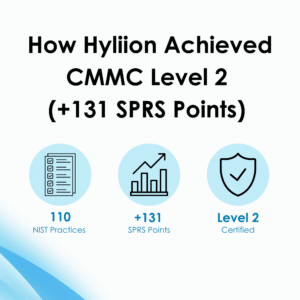
When Hyliion, a leading technology company developing hybrid and electric powertrain solutions for semi-trucks, needed cybersecurity expertise, they turned to Alluvionic. Pradeep Vulli, Head of IT, praised the collaboration, stating:

“The Alluvionic team was highly responsive and professional throughout the entire project. They consistently went the extra mile to answer our questions and meet our needs. We were particularly impressed with their ability to work closely with our internal team to develop a customized solution that met our specific requirements. Overall, we are extremely satisfied with their service quality, on-time delivery, and cybersecurity compliance efforts. We highly recommend Alluvionic to any organization seeking top-tier cybersecurity solutions.”

Our Proven Process for CMMC Success

Alluvionic simplifies CMMC certification with a structured, step-by-step process designed to help contractors at any stage of their compliance journey.

Understanding where you stand is the first step. We conduct a thorough assessment of your current cybersecurity posture, identifying gaps in security controls, policies, and procedures that may prevent CMMC certification. Based on this evaluation, we provide a customized roadmap to compliance, prioritizing areas that need attention and guiding you through necessary improvements.

CMMC compliance requires detailed policies, procedures, and documentation that align with regulatory standards. Our team helps you develop, refine, and streamline security policies to meet CMMC requirements. Whether it’s creating incident response plans, access control policies, or system security plans, we ensure your documentation is comprehensive, compliant, and assessment-ready.

Identifying security gaps is only half the battle—closing them is where the real work begins. Our experts coordinate the implementation of necessary cybersecurity controls, ensuring that your IT systems, networks, and processes meet CMMC standards. This may include:
  • Enhancing multi-factor authentication (MFA) for secure access
  • Implementing encryption protocols to protect Controlled Unclassified Information (CUI)
  • Establishing continuous monitoring and endpoint protection solutions
  • Strengthening physical and logical access controls
We work closely with your IT team to integrate these security measures without disrupting daily business operations.
The CMMC certification process can be stressful, but we make it manageable. Prior to scheduling your C3PAO assessment, Alluvionic provides comprehensive assessment preparation to ensure you are ready for the evaluation. We conduct mock assessments, review evidence, and coach your team to confidently demonstrate compliance.

Achieving CMMC certification is not a one-time event—it’s an ongoing commitment. With evolving cybersecurity threats and recertification required every three years, maintaining compliance is just as important as obtaining it. Defense contractors must continuously monitor and improve their cybersecurity posture to stay ahead of risks and ensure uninterrupted eligibility for DoD contracts.

At Alluvionic, we provide continuous monitoring and compliance maintenance to help businesses sustain their CMMC certification year after year. Our approach ensures that security controls remain effective, documentation stays up to date, and your organization is prepared for future audits or evolving regulatory changes.

How We Help You Stay Compliant

  • Regular Security Assessments – We conduct periodic evaluations to identify potential vulnerabilities before they become compliance issues.
  • Ongoing Policy & Documentation Updates – As regulations shift, we ensure your security policies, system security plans, and risk assessments remain aligned with the latest CMMC requirements.
  • Employee Security Awareness Training – Cybersecurity is only as strong as the people managing it. We offer ongoing training to keep your team informed of best practices and emerging threats.


CMMC is here to stay, and compliance is a long-term investment. Let Alluvionic help you maintain certification, strengthen your cybersecurity defenses, and protect your business for the future.

Act Now to Secure Your DoD Contracts

CMMC compliance is not optional—it’s the new standard for doing business with the DoD. With CMMC requirements being phased into contracts, now is the time to prepare.

Alluvionic makes the process simple, efficient, and cost-effective, so you can focus on your core business while we handle compliance.

Contact us today to schedule a consultation and take the first step toward securing your CMMC certification.

Contact

  • This field is for validation purposes and should be left unchanged.

Read From Our Blog

We Treat Client Successes as Our Own

Download Our Project Assurance® Checklist

It’s simple. A project that gets off on the right foot is likely to take a successful journey. So why do so many projects fail? Use this checklist to assure your project succeeds from the beginning.

Whether you need project management, process improvement, cybersecurity,  product development, training, or government services,  Alluvionic has the expertise to provide Peace of Mind and Project Assurance®.

Where are you on your CMMC Journey?

Get Started

DOWNLOAD OUR PROJECT ASSURANCE® CHECKLIST

Fill out the form below to access our checklist that will ensure your project's success!