Organizations across industries are under constant pressure to deliver high-quality products and services on time, within budget, and with predictable results. During Alluvionic’s webinar, Introduction to CMMI: Building Better Processes for Business Success, a panel of experts explored how the Capability Maturity Model Integration (CMMI) framework helps organizations strengthen processes, improve performance, and drive long-term growth.
The discussion featured:
- Dan Payne, CMMI Lead Appraiser
- David Kresheck, CMMI Implementation Specialist and Management Consultant (SEM Perspective)
- Patricia Eglin, CMMI Implementation Specialist and Management Consultant (Client / Company Perspective)
Together, they shared practical insights into what CMMI is, why organizations adopt it, and how companies can begin their process improvement journey.
What Is CMMI?
CMMI is a globally recognized framework of best practices designed to help organizations improve quality, reduce risk, and achieve more consistent business outcomes.
According to Dan Payne, CMMI helps organizations deliver higher-quality products while improving project performance and reducing costly defects.
 “These best practices will help you mitigate some of the issues delivering a quality product to your customer. It will help reduce the number of defects found in production and help you manage the project and deliver on time and under budget.” — Dan Payne
While CMMI originated in software development, it has evolved into a flexible framework used across industries including defense, healthcare, manufacturing, insurance, and professional services.
Why Organizations Invest in CMMI
The panel emphasized that CMMI provides organizations with a foundation for consistent, repeatable success.
Patricia Eglin compared CMMI to the foundation of a house.
 “You need to have that foundation of standard process metrics and all the things that come from implementing CMMI so that you can not just build your processes and improve on them but build the organization on something that’s solid.” – Patricia Eglin
David Kresheck added that CMMI helps organizations create consistency across projects, leading to reduced costs, improved efficiency, and stronger competitive positioning.
Benefits often include:
- Improved product and service quality
- Better schedule and budget performance
- Greater process consistency
- Increased visibility into organizational performance
- Enhanced customer satisfaction
- Reduced operational risk
The Cost of Operating Without Standard Processes
Without a structured framework, organizations often rely on ad hoc approaches that make success difficult to replicate and problems harder to identify.
The panel noted that the absence of standardized processes can lead to schedule delays, budget overruns, inconsistent outcomes, and higher defect rates. For organizations operating in regulated industries, it can also create barriers to winning contracts and meeting compliance requirements.
As Patricia Eglin explained, standard processes help organizations understand what worked, what didn’t, and how to continuously improve future performance.
Understanding the Five CMMI Maturity Levels
Dan Payne outlined the five maturity levels within CMMI:
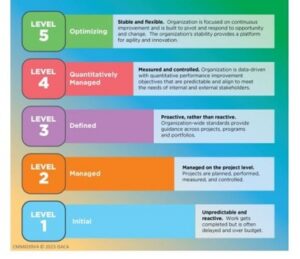 Level 1: Initial
Processes are reactive and inconsistent.
Level 2: Managed
Projects follow established management practices and procedures.
Level 3: Defined
Standardized processes are implemented across the organization.
Level 4: Quantitatively Managed
Organizations measure and control process performance through data.
Level 5: Optimizing
Continuous improvement is driven by performance analysis and lessons learned.
Most organizations pursuing CMMI focus on achieving Level 3, where processes become standardized and repeatable across the enterprise.
How Long Does Implementation Take?
One of the most common questions organizations ask is how long implementation takes.
The panel’s answer: it depends.
Factors such as organizational size, existing process maturity, leadership support, and company culture all influence the timeline. While some organizations may already have many CMMI-aligned practices in place, others require more significant changes.
In many cases, organizations can expect implementation efforts to range from approximately eight to twelve months.
Can CMMI Work with Agile?
A common misconception is that process frameworks and Agile methodologies are at odds. In reality, modern versions of CMMI are designed to support Agile, traditional, and hybrid approaches.
David Kresheck explained that the latest version of CMMI incorporates Agile principles such as collaboration, continuous improvement, adaptability, and customer-focused delivery, giving organizations flexibility in how they implement the framework.
Getting Started with CMMI
 For organizations considering CMMI adoption, the panel recommended beginning with a gap analysis to establish a baseline understanding of current processes and identify areas for improvement.
“You don’t know where you’re going on the map until you know where you are on the map.” — David Kresheck
This assessment helps organizations determine their current maturity, prioritize improvements, and create a realistic roadmap toward their desired goals.
Lessons Learned from Successful Implementations
One of the strongest themes throughout the discussion was the importance of leadership commitment.
The panel emphasized that successful implementations require active support from leadership and engagement across the organization. Process improvement should be viewed as a strategic business initiative rather than a compliance exercise or side project.
Dan Payne cautioned organizations against pursuing CMMI solely to achieve a rating or win a contract.
“Leadership should want process improvement for the sake of process improvement, not for the sake of obtaining that certification.” — Dan Payne
Organizations that integrate process improvement into their daily operations are more likely to see lasting business benefits.
Measuring Success
To determine whether a CMMI implementation is delivering value, organizations should establish baseline metrics before implementation and track performance over time.
Common measures include:
- Time to market
- Schedule performance
- Budget performance
- Defect rates
- Customer satisfaction
By measuring results before and after implementation, organizations can clearly demonstrate improvement and identify opportunities for continued optimization.

Watch the Full Webinar Replay
CMMI is more than a certification framework. It is a proven approach for improving quality, increasing efficiency, reducing risk, and building a foundation for sustainable growth.
As a trusted partner in process improvement, Alluvionic helps organizations implement practical, scalable processes that enhance performance and support long-term success. As a CMMI Institute Partner, ISO 9001-certified organization and Cyber AB Registered Practitioner Organization, Alluvionic provides process improvement consulting, CMMI implementation support, gap assessments, appraisal preparation, training, project management solutions, and related services to help organizations achieve their business objectives.
Whether your organization is just beginning its process improvement journey or looking to strengthen existing practices, our experts can help you develop sustainable processes that deliver measurable results.
Watch the full webinar replay to hear the complete discussion from our experts and learn how CMMI can help your organization build better processes for business success.