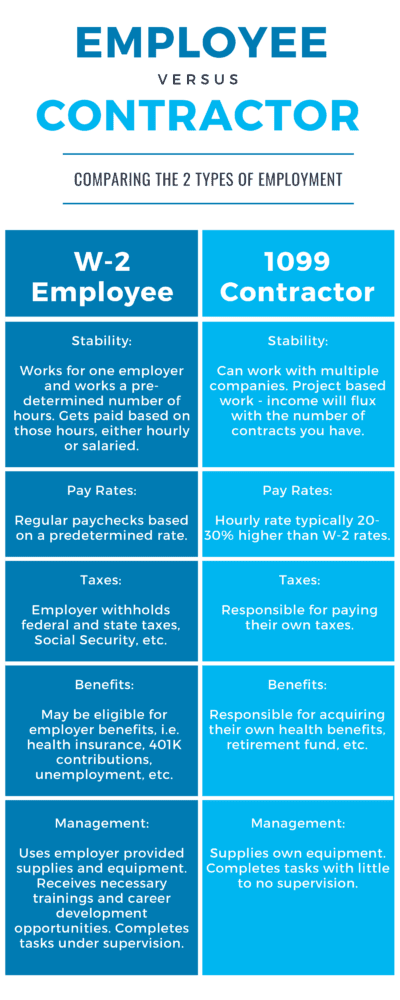
If you’ve ever wondered whether W2 employment or 1099 contracting is a better option for you, check out this simple infographic. Consider all the factors that impact this decision including stability, pay rates, taxes, benefits, and management.
W-2 vs. 1099: Understanding the Core Differences
Navigating the choice between W-2 employment and 1099 independent contracting is about more than just a job title; it defines your tax obligations, your level of autonomy, and your access to benefits. For businesses, this distinction is critical for resource planning and compliance. The following comparison highlights the fundamental differences in stability, pay, and management.
| Feature | W-2 Employee | 1099 Contractor |
|---|---|---|
| Stability | Works for one employer with pre-determined hours and regular pay. | Works for multiple companies; income fluxes based on project volume. |
| Pay Rates | Regular paychecks based on a pre-determined hourly or salary rate. | Hourly rates are typically 20-30% higher than W-2 rates to cover costs. |
| Taxes | Employer withholds federal, state, and Social Security taxes. | The contractor is responsible for paying all of their own taxes. |
| Benefits | Eligible for health insurance, 401K, and unemployment benefits. | Responsible for acquiring their own health insurance and retirement funds. |
| Management | Works under supervision using employer-provided equipment. | Supplies own equipment and completes tasks with little to no supervision. |
Frequently Asked Questions About Employment Classifications
Misclassifying workers or choosing the wrong employment path can lead to significant financial and regulatory hurdles. To help you make an informed decision—whether you are a professional looking for a new role or a business scaling for a government contract—we’ve answered the most common questions regarding W-2 and 1099 status.
Is it better to be a W-2 or 1099 worker?
Whether W-2 or 1099 is better depends on your need for stability versus flexibility. W-2 employees enjoy consistent pay and employer-paid benefits, while 1099 contractors benefit from higher hourly rates and the freedom to work for multiple clients simultaneously.
Does a 1099 pay more than a W-2?
Generally, 1099 contractors receive a 20-30% higher hourly rate than W-2 employees. This higher rate is intended to offset the cost of self-employment taxes, health insurance, and lack of paid time off.
Can a company have both W-2 and 1099 workers?
Yes, many organizations utilize a hybrid model. They may use W-2 employees for core operations and 1099 contractors for specialized projects or overflow work. Alluvionic often helps companies manage these complex project management structures efficiently.
Strategic Workforce Management for Your Next Project
Managing the balance between internal employees and external contractors requires expert project management. Whether you are scaling your team for a government contract or optimizing internal processes, Alluvionic provides the Project Management Consulting you need to stay compliant and efficient.