CMMC conversations across the Defense Industrial Base have entered a new phase. Certification requirements are now formally established, and organizations are currently grappling with timing, operational readiness, assessor availability, and growing pressure from prime contractors moving faster than the federal rollout itself.
During Alluvionic’s recent webinar, CMMC False Starts: Why Organizations Think They’re Ready and Aren’t, panelists from Alluvionic, Kratos Technology & Training Solutions, and CohnReznick Advisory LLC shared firsthand observations from the certification front lines. The discussion focused on a growing trend: companies enter the assessment process convinced they are prepared, only to discover foundational gaps once assessment planning begins.
The panel featured:
- Elizabeth Huy, EVP of Commercial Services, RP at Alluvionic (RPO)
- Bobby Padilla, Information Security Director, CCP at Alluvionic (RPO)
- Cole French, Director Cybersecurity Services at Kratos Technology & Training Solutions (C3PAO)
- Steve Gilmer, Director Cybersecurity, Technology Risk and Privacy Global Consulting Solutions at CohnReznick Advisory LLC (C3PAO)
Several themes surfaced repeatedly throughout the session.
Prime Contractors are Accelerating the Timeline
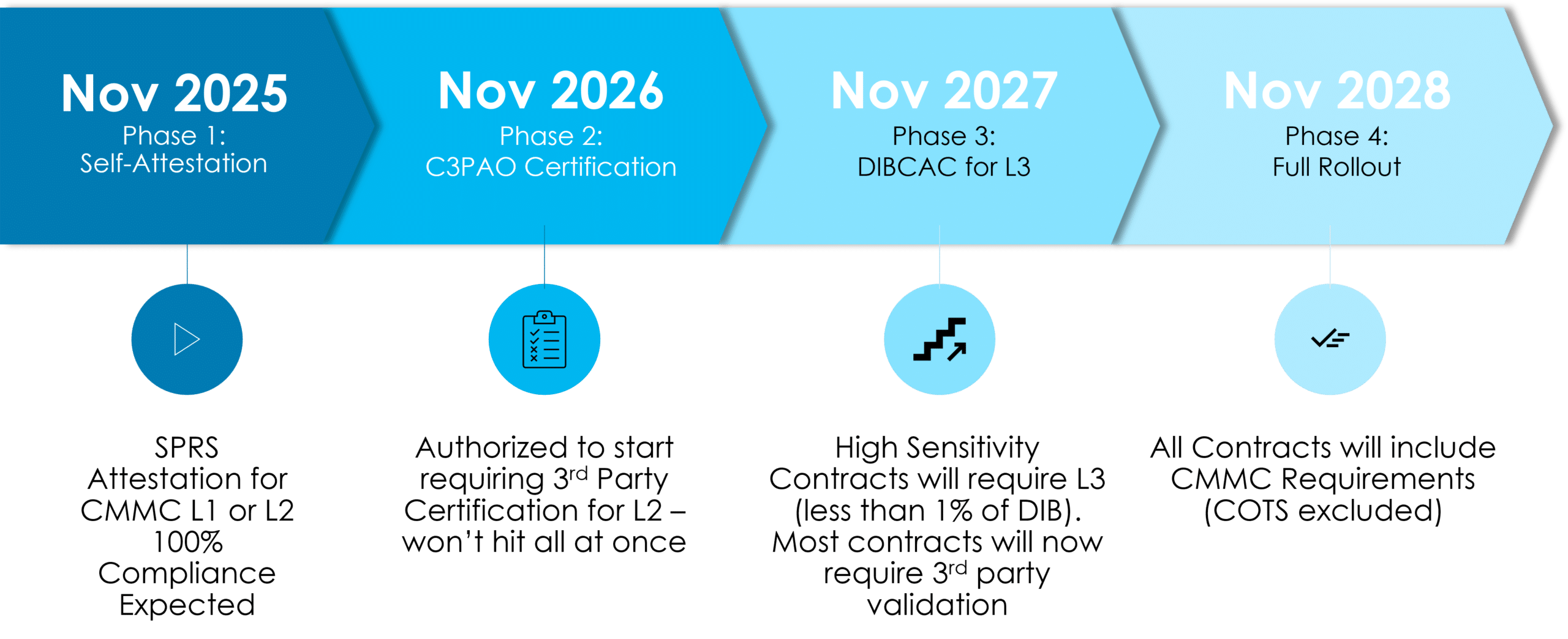
One of the clearest takeaways from the webinar was that many subcontractors are already facing certification expectations well ahead of the government’s formal phased rollout schedule.
The panel reviewed real examples of prime contractors requiring subcontractors to achieve CMMC Level 2 certification within aggressive timeframes. In some cases, companies received requests demanding certification within only a few months.
 Steve Gilmer of CohenReznick noted that prime contractors are increasingly pushing accelerated readiness expectations into their supply chains:
“If you’re going to continue participating on contracts, many primes are expecting organizations to move up their timeline ahead of what the government has published.”
The discussion made one point especially clear: many organizations are no longer planning against a federal deadline alone. They are planning against customer expectations that may arrive much sooner.
The Ecosystem Is Facing a Capacity Crunch
The webinar also explored the growing mismatch between the number of organizations expected to require certification and the current assessment capacity available across the ecosystem.
The panel noted that approximately 80,000 defense contractors are expected to require CMMC Level 2 certification, while only a small fraction have completed certification to date.
Steve Gilmer broke down another layer of the challenge by explaining how assessments are staffed:
“Every engagement will have a lead CCA, a second CCA, and a QA CCA. Currently, there are less than 800 CCAs and less than 500 lead CCAs.”
That structure creates natural throughput limitations even as more C3PAOs enter the market.
 Cole French also pointed to increasing accreditation requirements that may place additional pressure on smaller assessment organizations:
“There’s good potential that that could put downward pressure on the number of C3PAOs.”
For organizations hoping to secure assessments late in the cycle, scheduling pressure continues to grow.
Scope Confusion Continues to Derail Readiness
When the conversation turned to early false starts, all three panelists quickly identified scoping confusion as one of the earliest and most common warning signs.
Organizations frequently begin assessment preparation without fully understanding:
- Where CUI resides
- Who interacts with it
- Which systems belong inside scope
- How data moves operationally
- Which business processes expand exposure
Cole French described scope as the starting point for the entire assessment process:
“We can’t conduct an assessment if we don’t have a well-defined scope that adheres to the CMMC scoping guide.”
The panel emphasized that CMMC readiness begins long before documentation review. Organizations first need a precise understanding of how Controlled Unclassified Information flows through their environment.
Revision 2 and Revision 3 are Still Being Mixed Up
Another recurring issue discussed during the webinar involved organizations unintentionally preparing against the wrong version of NIST SP 800-171.
Because Revision 3 is prominently displayed on NIST resources, companies researching compliance independently often begin implementing Revision 3 controls without realizing that current CMMC assessments remain aligned to Revision 2.
 Bobby Padilla explained the practical impact this creates during assessment preparation:
“You will be certified on revision 2, and therefore, if you’re implementing revision 3, there’s most likely going to be some misalignment.”
The discussion highlighted how easily organizations can drift away from assessment expectations when they attempt to navigate the framework without experienced guidance.
For more on the revision differences, explore: Before You Rebuild Your CMMC Program for NIST 800-171 Rev. 3, Read This
CMMC Requires Operational Alignment Across the Business
Throughout the webinar, panelists repeatedly challenged the assumption that CMMC belongs solely to the IT department.
The conversation expanded well beyond technical controls and focused heavily on operational coordination across the organization.
The panel discussed the involvement of:
- HR teams
- Facilities and physical security personnel
- Manufacturing operations
- Executive leadership
- Compliance functions
- Business operations
- System administrators
Cole French explained how even common personnel security processes require cross-functional coordination:
“It’s going to take coordination between your HR function and your IT function.”
Steve Gilmer framed the broader shift this way:
“CMMC is about situational awareness and operational awareness.”
He later added:
“I personally have always approached it as a culture first, IT second.”
That perspective shaped much of the webinar discussion. Successful readiness programs are embedding security practices into operational behavior across the business, not simply deploying technical tooling.
Technology Purchases Alone Do Not Prepare Organizations for Assessment
The panel also addressed one of the most persistent misconceptions in the market: the belief that purchasing a product or platform creates compliance automatically.
Bobby Padilla described conversations with organizations assuming a newly purchased solution resolved broad portions of the framework:
“Many falsely believe, ‘I purchased this tool, so I’m compliant’.”
Steve Gilmer reinforced the importance of understanding operational responsibility behind any technology investment:
“There is no easy button.”
The panel encouraged organizations to evaluate how tools integrate into documented processes, governance, oversight, and evidence generation rather than viewing products as standalone compliance solutions.
Evidence Readiness Continues to Separate Successful Assessments from False Starts
Toward the end of the discussion, the panel explored another major readiness issue: evidence maturity.
Organizations often focus heavily on writing policies while underestimating the amount of operational evidence required during assessment activities.
 Steve Gilmer explained that organizations benefit from establishing repeatable processes early and thinking about evidence early on.
The webinar reinforced that assessors are evaluating whether organizations consistently execute their stated processes, not simply whether documentation exists.
That distinction continues to shape many of the false starts organizations experience during assessment preparation.
Final Takeaways
The webinar closed with a practical message for contractors navigating the current CMMC environment.
Organizations gaining traction in their readiness efforts are typically the ones investing early in:
- Scope definition
- Process maturity
- Operational alignment
- Documentation accuracy
- Evidence collection
- Cross-functional coordination
- Leadership engagement
The panelists encouraged organizations to treat readiness as an operational discipline that develops over time rather than a last-minute compliance exercise.
Watch the Replay
Looking for more? Watch the full webinar replay.