ICYMI: Insights from Our Webinar — CMMC Contract Clause DFARS 252.204-7021 Explained
The CMMC landscape shifted in a major way with the release of DFARS 252.204-7021, formally embedding CMMC into the DoD contracting process. To help organizations understand what this means, Alluvionic brought together cybersecurity experts and certified C3PAO assessors for a detailed and candid discussion about timing, requirements, risks, and readiness.
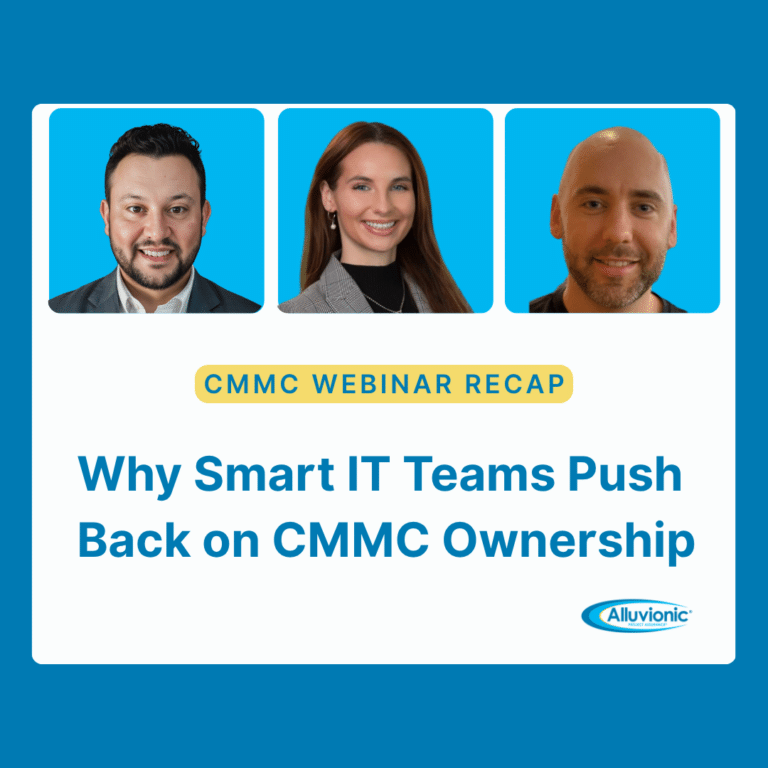
Moderated by Elizabeth (Lizi) Huy, EVP of Commercial Services at Alluvionic and Cyber AB Registered Practitioner (RP), the panel included:
- Bobby Padilla, Information Security Director, CCP, Alluvionic, Inc., RPO
- Mike Crandall, Founder & CEO, CCA, Digital Beachhead, C3PAO
- Matt Bruggeman, Director of Federal Sales, CCP, A-LIGN, C3PAO
In this article:
- When Will CMMC Be Required for You?
- What are the Consequences of an Inaccurate Self-Attestation?
- Should You Consider a CMMC Consultant?
- Is There a Minimum Score for Self Attestation?
- Is There a C3PAO Bottleneck?
- When Should You Schedule Your Assessment?
- How Can Small Businesses Afford CMMC?
- Final Takeaways
The DFARS 252.204-7021 Clause Is Live — and So Are the Requirements
Effective November 10, 2025, DFARS 252.204-7021 ushers in mandatory CMMC for the Defense Industrial Base (DIB). As Bobby Padilla explained, this clause now formally requires contractors to obtain the appropriate level of certification based on the contract’s stated requirements.
Key point:
Your need for CMMC depends on the sensitivity of the data you handle and the contracts you pursue. But the timelines matter:
- 2026 – Self-attestation begins
- 2027 – Third-party C3PAO assessments required for new solicitations
- 2028 – Full rollout complete
If you wait until 2028 to start preparing, you may already be locked out of opportunities.
As Bruggeman noted, most contractors are now entering serious “project-planning mode,” trying to understand both timing and cost so they can incorporate CMMC into 2026 budgets.
When Will CMMC Be Required for You? It Depends.
The honest answer?

“We cannot come to you specifically and say X date is when you are going to see your first requirement.” — Matt Bruggeman, Director of Federal Sales, CCP, A-LIGN, C3PAO
Several factors influence timing:
- What contracts are you bidding for?
- When would the contract be awarded?
- What data will you handle — FCI, CUI, or neither?
- Who is the prime contractor?
- What flow-down requirements apply?
One trend is already clear:
Prime contractors are not waiting. Many are requiring subcontractors to undergo formal Level 2 assessments now to mitigate program risk.
What are the Consequences of an Inaccurate Self-Attestation?
Many contractors assume they can simply self-attest for now and delay true preparation, misreading the phased rollout as extra time. But as Mike and Bobby emphasized, that’s a risky strategy.

Even self-attestation triggers accountability:
“If you inflate your SPRS score… you’re still subject to the 7019 clause and open yourself up to DIBCAC audit and False Claims Act exposure.” — Bobby Padilla, Information Security Director, CCP, Alluvionic, Inc., RPO
DIBCAC is already actively auditing companies with high self-reported scores, and both Bobby and Mike shared recent stories of organizations that were targeted — and failed — because their self-assessments weren’t accurate.
Bottom line:
If you can’t honestly claim 110/110 practices implemented, do not self-attest to Level 2.
Why You Should Consider a CMMC Consultant
The panel was clear: most organizations unintentionally misinterpret controls.

“If you’re not the CMMC professional… you don’t know what the Cyber AB and the DoD is looking for.” — Mike Crandall, Founder & CEO, CCA, Digital Beachhead, C3PAO
DIBCAC and C3PAOs have very specific expectations. A consultant or RPO can:
- Validate your control implementation
- Identify incorrect interpretations
- Point out gaps your team may overlook
- Prepare you for the real assessment
- Reduce costly delays
And importantly:
The “easy button” doesn’t exist — no tool or MSP can “make you compliant.” The OSC is always ultimately responsible for all 110 controls.
Is There a Minimum Score for Self Attestation? Yes — 110 Out of 110
There is no partial self-attestation.
“In order to meet Level 2, you have to meet all 110 controls and be compliant.” — Mike Crandall
During a formal assessment, you may qualify for a conditional certificate if you meet at least 88 weighted points — but:
- This applies only to C3PAO assessments
- It does not apply to self-attestation
- You must still believe you’re a full 110/110 to start an assessment
Backlog Reality: Is There a C3PAO Bottleneck?
Yes — and it will grow.
- There are currently less than 90 C3PAOs in the ecosystem
- Demand is rapidly increasing
- Backlogs vary by firm size and assessor availability
Backlogs at present:
- Larger C3PAOs: around 3 months
- Smaller teams: 3–6+ months
So, When Should You Schedule Your Assessment?
The consensus answer:
As soon as you can legitimately self-attest, or when you are ~80% implemented with known, short-term POAMs.
Why so early?
- C3PAO backlogs vary but will inevitably grow
- MSP or technology decisions may delay readiness
- Assessment evidence requires historical data, not “day-one” implementation
Matt described the ideal scenario:
- Understand your scope
- Know your remaining POAMs
- Have the technology purchased
- Be confident that remaining items are on track
Most C3PAOs allow clients to contract months ahead, reserve a slot, and adjust the timeline as needed.
How Can Small Businesses Afford CMMC?
For small businesses, the cost can feel daunting. Mike offered simple but powerful advice:
Reduce your scope → reduce your cost.
Strategies include:
- Creating a CUI enclave
- Using virtual environments
- Limiting how many employees access CUI
- Re-mapping workflows so CUI only touches necessary systems
Some small firms may need to make strategic decisions about whether DoD work remains viable if compliance costs exceed expected revenue.
Final Thoughts: Prepare Early, Prepare Accurately, Prepare Strategically
Across the webinar, a consistent message emerged:
- CMMC is now mandatory according to contract requirements.
- Inflated self-attestations carry real consequences.
- Accurate scoping and honest scoring are essential.
- Preparation takes more time than most organizations expect.
- Your MSP and RPO must be involved — early and often.
- You should plan and budget now for 2026 and beyond.
Most importantly:
Don’t go it alone. Whether you’re validating your SPRS score, preparing for assessment, designing an enclave, or evaluating a contract’s requirements, Alluvionic and our C3PAO partners can help guide you.
Watch the full webinar now