For contractors across the defense industrial base, the CMMC timeline is moving faster than expected.
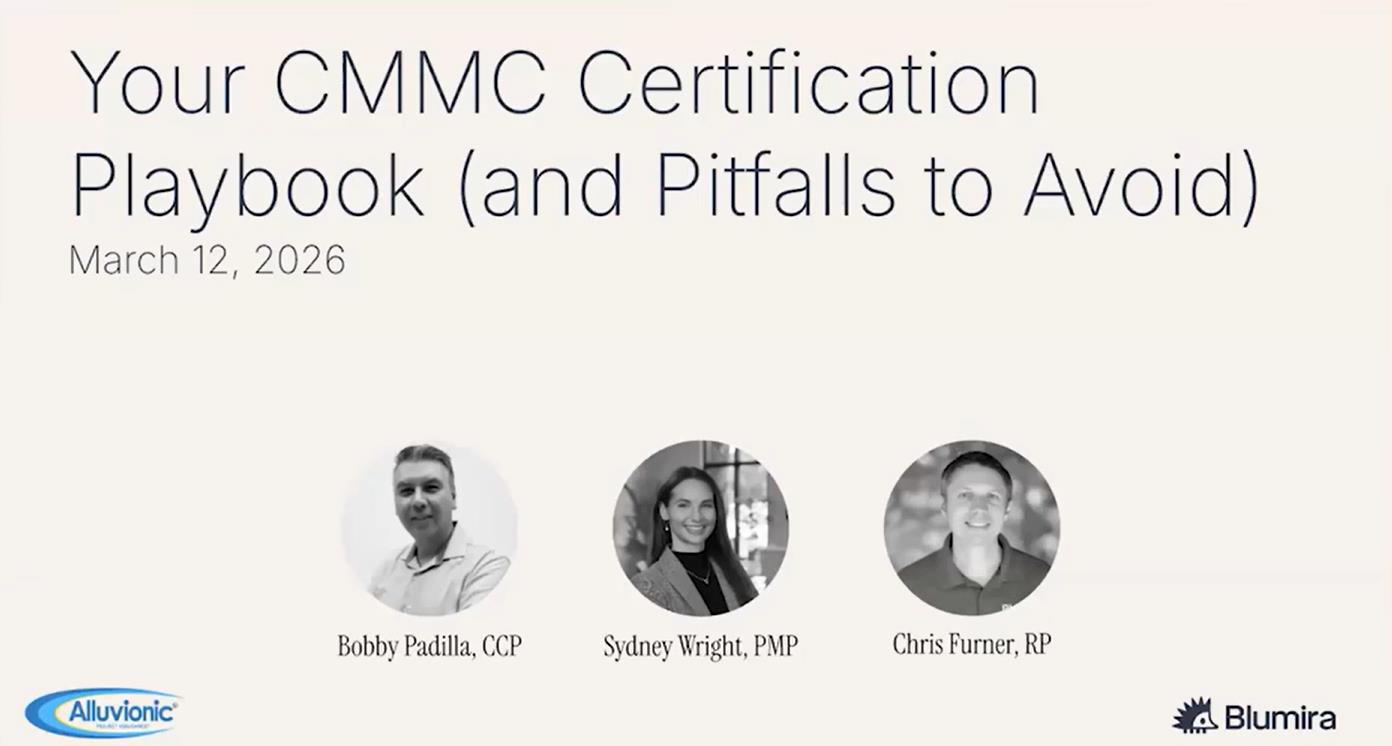
In the recent webinar, “Your CMMC Certification Playbook (and Pitfalls to Avoid),” the presenters discussed the current CMMC landscape, the most common certification pitfalls, and the practical steps contractors can take now to avoid delays.
Featured speakers:
- Sydney Wright, PMP — Project Manager, Alluvionic
- Bobby Padilla, CCP — Information Security Director, Alluvionic
- Chris Furner — Head of Partner Enablement, Blumira
The discussion focused on one central theme: getting CMMC Level 2 ready is not something most organizations can leave until the last minute. Between scoping, remediation, documentation, technical implementation, and assessment preparation, the process takes time. And in many cases, primes are already accelerating the deadline.
Here is the big-picture recap.
The November 2026 date is closer than it looks
One of the biggest misconceptions in the CMMC conversation is that contractors have until 2028 to worry about certification. That is not how the rollout is playing out in practice.
As discussed in the webinar, November 2026 is the date many contractors should be watching most closely. That is when Level 2 requirements become much more consequential for organizations pursuing new DoD work.
 Chris Furner of Blumira captured the urgency well:
“By the end of this year, you’re going to see cases where you can no longer get that business unless you do have that assessment done.”
That is the practical reality many contractors need to plan around. Even if 2028 remains the full maturity point for the program, companies that wait for that milestone may find themselves shut out of opportunities much sooner.
The takeaway is simple: plan around when you need to compete, not around the latest possible enforcement date.
Prime contractors are already moving earlier than the rule requires
A second theme that came through clearly is that formal policy timelines are only part of the story. In the real world, prime contractors are often setting expectations ahead of the government’s phased rollout.
 As Bobby Padilla shared during the session:
“We’re starting to see a lot of clients that are coming to us for support because their prime contractor is really just moving up that date.”
In other words, some primes are not willing to rely on temporary self-attestation. They want suppliers to demonstrate stronger readiness earlier, because they are managing their own contractual and operational risk.
That matters for subcontractors of every size. For many organizations, the effective deadline is not just the government’s deadline. It is whatever the prime says is necessary to stay in the pipeline for upcoming work.
Small businesses are feeling the pressure most
Another major point from the webinar was the pressure CMMC is placing on small and mid-sized businesses, especially those without mature internal IT or compliance resources.
 Sydney Wright noted that this is not limited to traditional cybersecurity-focused firms or large defense contractors:
“We’ve even seen some small electricians that work with these larger primes and then they’re forced into complying with these.”
That reality is important. CMMC readiness is reaching deep into the supply chain. Organizations that may never have considered themselves “cybersecurity-heavy” businesses are now being asked to meet the same baseline expectations for handling controlled information.
That can feel overwhelming, but it also underscores why early planning matters. The earlier an organization understands its scope and requirements, the more realistic and manageable the path to compliance becomes.
Scoping is where many readiness efforts go wrong
If there was one topic that stood out as the most common readiness challenge, it was CUI scoping.
At Alluvionic, we consistently see scoping drive the entire direction of a CMMC effort. Before an organization can remediate gaps, build documentation, or prepare for an assessment, it needs to know exactly where CUI lives, how it moves, who handles it, and which systems fall inside the boundary.
Bobby described it as starting with the CUI data flow: understanding all the paths and places where controlled unclassified information moves through the organization.
When scoping is not done correctly, organizations often end up with avoidable compliance problems. One of the most common examples discussed in the webinar was cloud storage.
As Bobby explained:
“Commonly, we’re seeing CUI being stored in the Microsoft commercial cloud.”
He went on to make the compliance issue plain:
“…But on the Microsoft commercial cloud, the storage of CUI is not authorized.”
This is a frequent issue for small businesses because Microsoft commercial tools are widely used, easy to deploy, and familiar to employees. But convenience is not the same as authorization, and many companies discover this only after they are already deep into readiness work.
The lesson here is critical: scoping is not a paperwork exercise. It is the foundation of the entire certification effort.
GCC High is not the only option
Once organizations realize their current environment is not appropriate for CUI, many immediately assume the answer is GCC High. While that is one valid path, it is not the only one.

Bobby addressed that directly during the webinar:
“GCC or GCC High is an option, but it’s not the only option.”
That distinction matters because cloud strategy should be driven by your environment, your users, your operational needs, and your budget. Some organizations are well-positioned for a Microsoft government cloud migration. Others may be better served by different authorized solutions paired with the right security and support model.
The key is not choosing the most talked-about environment. The key is choosing an environment that supports compliant handling of CUI and fits your organization’s actual needs.
Evaluating options for handling CUI? This comparison of Microsoft GCC High and PreVeil offers a helpful overview: https://www.preveil.com/preveil-vs-microsoft-gcc-high/.
A FedRAMP solution alone does not make you compliant
A related misconception is that once CUI is stored in a FedRAMP-authorized environment, the compliance problem is solved.
Sydney called out that assumption directly:
“Just having that and having your CUI live in that does not mean that all of your documentation and other technical implementations are up to compliance.”
She added an important qualifier:
“That is an excellent step toward controlling the CUI and access, but it’s not everything.”
This is one of the most important mindset shifts organizations need to make. CMMC is not a product purchase. It is not a licensing decision. It is not a single environment change. It is a combination of technical controls, documented processes, implemented procedures, training, evidence, and organizational discipline.
A compliant hosting solution can support the effort, but it cannot replace the effort.
Why many companies still need outside help
There are plenty of self-assessment tools available, and they can be useful for helping organizations get oriented. But tools alone do not solve the core challenge, especially for teams that are new to the language and expectations of CMMC.
Sydney explained why many companies still turn to a Registered Practitioner Organization or consultant:
“It is a huge undertaking because not only are there 110 controls, but you have another 320 objectives to comply to.”
She also put it plainly:
“That is mostly why people come to us — just because of the understanding or even the manpower.”
That lines up with what we see every day. Many organizations are willing to do the work. What they lack is clarity on how to interpret requirements, how to organize evidence, how to structure an SSP, or how to prioritize remediation in a way that will hold up during assessment.
A readiness effort tends to go much more efficiently when there is a clear roadmap from the beginning.
The “pass with an 88” idea is often misunderstood
One of the most useful moments in the webinar was the discussion around scoring and the persistent myth that an organization can go into an assessment with an 88 score and fix the rest afterward.
Sydney addressed that head-on:
“Simply just getting yourself 80% there is not good enough.”
And she offered the practical rule of thumb we recommend to clients as well:
“You really should be at that 110 when you go into assessment.”
This means that relying on partial compliance as your primary strategy is risky, expensive, and often misunderstood. Certain controls carry much greater consequence, and missing the wrong one can undermine the entire assessment.
The safer and smarter path is to go in fully prepared.
Failing an assessment is not a dry run
That leads directly to another point the webinar made clearly: an assessment should not be treated as a test run.

Sydney put it in the terms most leadership teams understand:
“The assessments are expensive. So, if you fail it, guess what? They’re going to make you pay for it again.”
That is why readiness is so important. The costs of rushing into an assessment are not only financial. They also include lost time, internal disruption, leadership frustration, and delayed business opportunities.
Her advice on preparation was equally direct:
“You better have all of your evidence ready to go. Your documentation better reflect what you’re doing.”
That alignment between practice and documentation is where many organizations either build confidence or create risk.
Technical details still matter
The webinar also touched on an important technical point that illustrates a broader truth about CMMC: the details matter.
When asked whether firewalls in scope need to run FIPS-validated firmware, Bobby answered clearly:
“The short answer, yes.”
He added the practical qualifier:
“If your firewall is in scope, which it most likely will be if you’re processing, storing, transmitting CUI inside your facility.”
This is a useful reminder that CMMC is not just about having policies on paper. It is also about whether the technical environment actually reflects the documented controls and expected standards.
Encryption, endpoints, network devices, logging, and access controls all need to be addressed with the same seriousness as policies and procedures.
For a closer look at how missing FIPS-validated encryption can derail a CMMC assessment, read this article: https://alluvionic.com/cmmc-level-2-cui-protection-nist-sp-800-171-cmmc-compliance-gap/
The real playbook: start early, scope correctly, and build for sustainment
If there was a single message to take away from the webinar, it is this: CMMC readiness is a business program, not a last-minute IT project.
Organizations that succeed tend to do three things well.
First, they start early enough to understand their environment and close meaningful gaps without rushing.
Second, they scope correctly, so they are solving the right problem and not wasting time or money on the wrong one.
Third, they treat CMMC as an ongoing operational responsibility, not a one-time hurdle. Certification is only part of the story. Sustainment is what keeps the business positioned for future work.
For contractors that are still trying to figure out where to begin, the best first step is usually a structured gap assessment. It provides a clear view of what is in scope, where the gaps are, how severe they are, and what the remediation path should look like.
That clarity is what turns CMMC from an intimidating unknown into a manageable project.
Need help getting started?
At Alluvionic, we help organizations navigate CMMC readiness from initial scoping and gap assessment through remediation, documentation, and assessment support. Whether you are just starting to evaluate your requirements or trying to close the final gaps before assessment, the goal is the same: build a defensible, sustainable compliance program with confidence.
Watch the Full Webinar Here
Want the full story on common CMMC pitfalls? Watch the full webinar recording here: