
 For prime contractors, CMMC readiness does not stop at their own organization. Suppliers that handle Federal Contract Information (FCI) or Controlled Unclassified Information (CUI) can have cybersecurity requirements of their own, and many are still trying to understand what those requirements mean and where to begin.
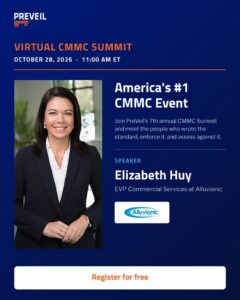
That was the focus of Getting Your Subs Compliant Fast: The Sub Starter Kit, a session at the 2026 PreVeil CMMC Summit featuring:
- Elizabeth Huy, EVP of Commercial Services and Cyber-AB Registered Practitioner at Alluvionic
- Manas Das, CEO of Strategic IT Solutions, an authorized C3PAO, and Lead Certified CMMC Assessor
The discussion looked beyond simply telling suppliers they need to comply. The speakers explored what primes can do to help suppliers move from confusion to action, where suppliers commonly get stuck, and what sustainable CMMC readiness actually looks like.
Here are the key takeaways from the session.
Many Suppliers Are Still Starting at Square One
One of the biggest challenges is awareness.
Huy said smaller organizations deeper in the supply chain often learn about CMMC only after a prime tells them a requirement applies.
“They’re often confused. They need a full education, and they don’t even know where to start.”
Suppliers may also be unclear about the information they receive, whether it qualifies as CUI, what systems are involved, and what requirements have been flowed down through their subcontract.
That creates an important role for primes: provide clarity early.
A prime should help suppliers understand what contractual requirements apply, what type of information may be shared, how that information is expected to move between organizations, and when readiness is needed. The supplier then owns its scope, implementation, documentation and assessment readiness.
CMMC Is Bigger Than an IT Project
Another theme came through clearly: installing technology is only one part of readiness.
Das described CMMC as an organizational maturity effort involving technology, processes and change management. Programs driven entirely by IT can run into trouble when written requirements do not match how employees actually work.
“The most successful CMMC compliant companies are where the senior executives have a say in it and they are driving it.”
During an assessment, policies, procedures, technical controls and employee practices need to tell the same story.
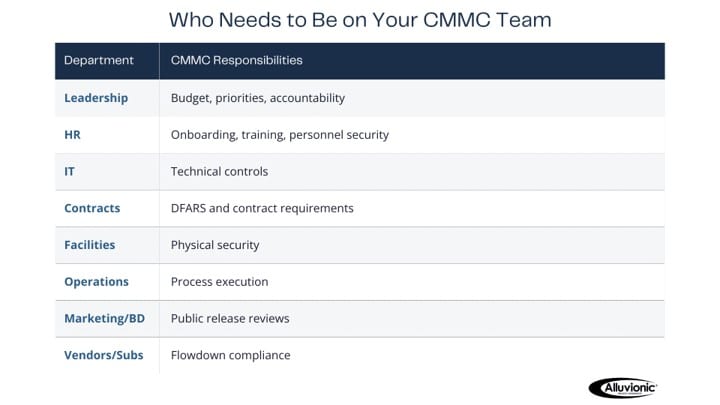
That means leadership, IT, operations and the people working inside the environment all have a role in building a sustainable program.
For more on this topic, see Alluvionic’s discussion of why CMMC requires more than IT.
Give Suppliers a Baseline and a Path Forward
When primes ask Alluvionic to support their supply chains, Huy said the first objective is often simply getting suppliers moving.
That can include:
- Understanding the applicable requirements
- Assessing the current environment
- Establishing baseline documentation such as a System Security Plan (SSP)
- Identifying gaps and developing a Plan of Action and Milestones (POA&M)
- Establishing an assessment score when applicable
- Creating a realistic plan for remediation and long-term compliance
The point is to move the supplier from “I don’t know what I need to do” to a documented understanding of its current state and next steps.
The CMMC Supplier Readiness Roadmap developed for the session turns that discussion into a practical sequence. For suppliers, it recommends starting with the contract and information flow, defining scope, establishing a baseline, deciding how gaps will be closed, and then implementing and sustaining the required protections.
Download the CMMC Supplier Readiness Roadmap
Assessment Readiness Means Showing That the Program Works
Completing a control checklist is not the finish line.
Das cautioned that organizations sometimes focus on implementing requirements without allowing enough time for those practices to become operational. During an assessment, the assessor is looking for evidence that the organization is actually doing what its documentation says it does.
His recommendation:
“Give yourself enough time to actually do what you said you will do.”
That means procedures need to be used, users need to be trained, evidence needs to accumulate and documentation needs to reflect the real environment before the assessment begins.
Beware of the CMMC “Easy Button”
The growing CMMC market gives suppliers plenty of technology, platform and consulting options. That can also make purchasing decisions harder.
Huy warned against choosing a solution based only on a promise that it addresses a certain percentage of requirements.
Instead, she recommended comparing the full investment:
What does it cost upfront? What does it take to operate? What else will still be needed? What will years two and three look like?
“There’s not an easy button out there. This is really changing the way that your organization operates.”
Scope matters too. A smaller enclave may make sense for an organization with a limited number of users handling CUI, while another contractor may need a broader environment. Technology decisions should follow an understanding of the requirements and scope rather than drive them.
The roadmap summarizes the principle simply: understand the requirements, define the scope and establish a baseline before making technology and implementation decisions.
Should Primes Tell Suppliers Which Tools to Use?
There can be value in a prime recommending a platform or provider. Suppliers may benefit from the prime’s experience, resources and support.
But Das cautioned that the same solution will not fit every supplier.
A small business with five users handling CUI has different operational and financial considerations than a large defense contractor. Suppliers also need to consider where they want their business to go.
The goal should be a solution that works today but can also scale if the supplier wins additional contracts or begins working with other primes.
For primes, that means providing useful resources and introductions without taking ownership of the supplier’s compliance program.
AI Can Help With Documentation, but It Cannot Replace the Program
The panel also addressed a growing question: can contractors use AI to create CMMC documentation?
Das said AI can provide a useful starting point, but generic policies still need to be reviewed and customized around the organization’s actual environment and practices.
“You cannot take generic documentation and say that this is our policy or procedure.”
The organizations using AI most effectively, he said, are using it to accelerate an initial draft and then tailoring the result to their own operations.
The principle is the same as the rest of CMMC readiness: your documentation should describe what your organization actually does.
What About the CMMC Phase II Pause?
The speakers also addressed the CMMC Phase II suspension.
Huy’s message to suppliers was to separate certification timing from the cybersecurity requirements already contained in contracts.
“Whatever is in the contract is still in the contract.”
That remains consistent with the Department of War’s current public guidance. On July 13, 2026, the Department suspended CMMC Phase II requirements that had been scheduled to begin November 10, 2026. Phase I self-assessment requirements remain in effect, and the Department specifically stated that contractors and subcontractors remain obligated to protect covered defense information under DFARS 252.204-7012.
As of November 5, the Department’s official CMMC pages still reflect that suspension while the program is under review. Recent reporting has outlined potential reform options emerging from the review, but final changes have not yet been formally adopted.
Contractors can monitor the Department of War CMMC resource page for official updates.
Read more: CMMC Phase II Suspension FAQs
A Practical Roadmap for Primes and Suppliers
The webinar’s biggest takeaway is that effective supplier readiness starts with a clear division of responsibility.
Primes: identify impacted suppliers, flow down the appropriate requirements, explain expectations, give suppliers useful resources and remain available for contract and data-flow questions.
Suppliers: understand the requirement, define scope, assess the current environment, build a realistic remediation plan, implement the protections and maintain evidence that those practices are operating.
The downloadable CMMC Supplier Readiness Roadmap walks both sides through that process. It includes:
- A step-by-step guide for primes supporting their supply chains
- A Supplier Starter Kit outlining what to tackle during the first stages of readiness
- Questions suppliers should answer before investing in technology
- A real-world case study showing how Convergint Federal supported supplier Chesapeake & Midlantic Marketing from flow-down communication through assessment, remediation, documentation and SPRS scoring
Download the CMMC Supplier Readiness Roadmap
Watch the Full Webinar Replay
The full session goes deeper into supplier education, assessment preparation, technology decisions, AI-generated documentation, the CMMC pause and what both primes and subcontractors can do now.
Watch: Primes: How a Defense Contractor Got Its Suppliers CMMC Compliant