When organizations talk about AI adoption, the conversation usually starts with technology: which tools to use, how to train employees, what policies to create, and how quickly teams can put new capabilities to work. At Alluvionic, our rollout started with a more practical question: where were we supposed to find the time?
Like most organizations, we were not sitting around waiting for an AI initiative. Our project managers were managing projects. Recruiters were filling positions. Marketing was running campaigns. Business development was pursuing opportunities. Client work still needed to be delivered. Adding AI training, experimentation, and new ways of working on top of existing responsibilities created a very real challenge.
That reality shaped the way we approached adoption from the beginning. If AI felt like one more task competing for attention, it would be difficult for employees to make meaningful progress. We needed the rollout to connect directly to the work people were already doing and help them move that work forward.
Starting With People, Not Technology
Before expanding access broadly, we launched an AI Champion program with a small group of employees representing different parts of the organization. The objective was simple: learn together, test real-world use cases, and share what worked.
The early conversations were refreshingly honest. Team members discussed the pressure of completing assignments correctly, keeping up with training modules, selecting meaningful capstone projects, and finding time to experiment while managing day-to-day work. They wanted the effort to produce something useful, not just satisfy a training requirement.
Those discussions reinforced an important lesson: people adopt new technology when they can see how it supports the work already on their calendars. That became the foundation for how we introduced AI across the company.
Learning Is Easier When You’re Not Learning Alone
 Another theme emerged quickly: nobody had all the answers. As Wendy Romeu shared during an all-hands meeting, “We’re all learning how to use AI, and each of us is exploring it in different ways. When we share what we’re learning, we help everyone move faster.”
That philosophy influenced the rollout in a practical way. Instead of positioning AI expertise as something that belonged to a small group of specialists, we created opportunities for employees to learn from one another. The AI Champion program became a way to share lessons learned, test different workflows, and identify use cases that could benefit multiple departments.
Those efforts later expanded into “PlAIground”, a forum designed for employees to exchange prompts, tools, workflows, and discoveries as they continued experimenting with AI across the organization.
AI Is a Skill
One team member made an observation that helped shift how we thought about adoption: “Some people, when they Google, they get better answers or can find the answers quicker than others because it’s a skill. It’s the same with using AI.”
Providing access to AI tools was important, but access alone would not create results. Learning how to frame questions, provide context, refine prompts, evaluate outputs, and apply AI to specific business challenges required practice.
As training progressed, the conversation began to change. Employees started exploring how AI could support proposal development, marketing content, project documentation, onboarding, research, and administrative work. The focus moved from general curiosity to practical application.
Establishing Guardrails Early
As experimentation increased, so did the need for consistency. Questions emerged around approved tools, governance, data protection, ownership, and accountability. Those conversations led to AI guiding principles, governance processes, and oversight mechanisms designed to help employees use AI securely and responsibly.
Our guiding principle remained straightforward: employees are accountable for the work they produce, and AI serves as a tool that supports decision-making, analysis, communication, and execution. Human review remains a critical part of the process. Creating that structure helped employees explore new capabilities while operating within clear expectations.
From AI Pilots to Everyday Work
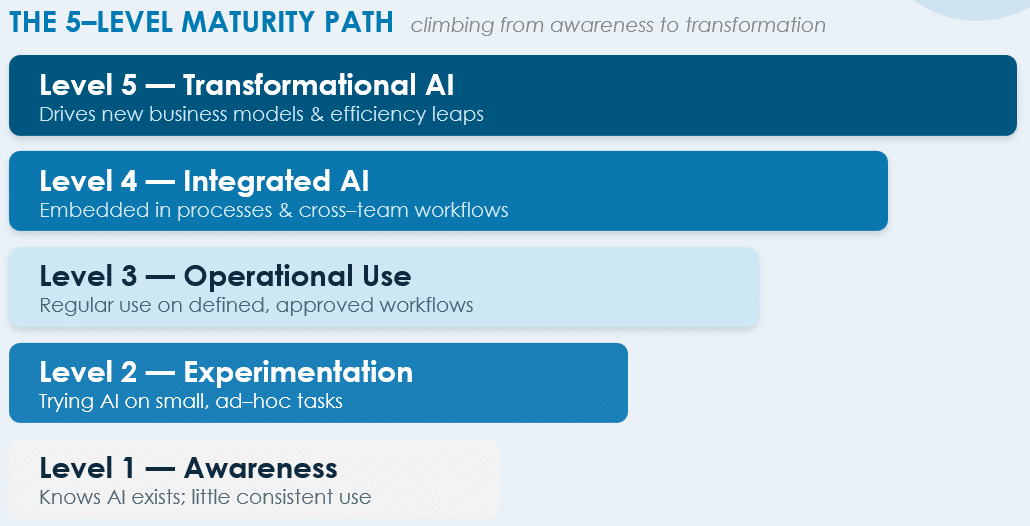
One of the biggest milestones was watching AI move from training exercises into everyday workflows. Project managers began streamlining training and client delivery documentation. Marketing teams tested content development and research workflows. Business development teams explored proposal support. Operations, HR, finance, and cyber teams began discussing automation opportunities and AI-enabled processes.
As the organization matured, those efforts expanded into AI agents, automation requests, governance reviews, and structured processes for evaluating new use cases. AI is now being explored across multiple business functions through pilots, workflow improvements, and ongoing experimentation.
What We Learned
The most important lesson from our rollout was simple: people rarely need another initiative competing for their attention. They need tools and processes that help them accomplish the work they are already responsible for.
That realization shaped our approach. We invested in training, created AI Champions, established governance, built opportunities for shared learning, developed practical use cases, and encouraged experimentation while maintaining accountability. Most importantly, we focused on helping people apply AI to real work rather than treating AI as a separate project running alongside it.
Our goal was to create practical value for our employees, our business, and our clients. That continues to be the standard we use as we move forward.