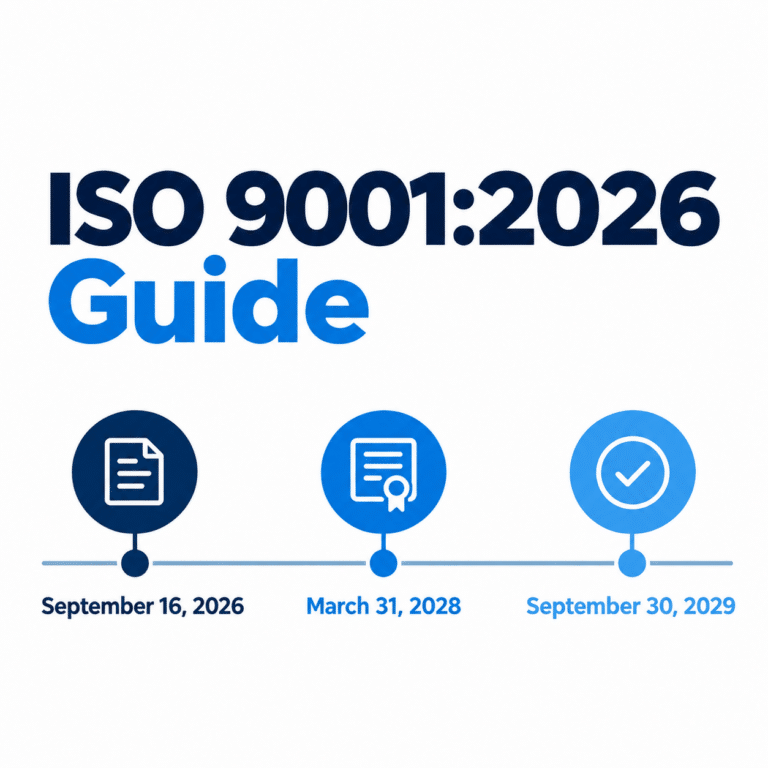
ISO 9001:2026 is the latest edition of the international standard for quality management systems.
For organizations implementing ISO 9001 for the first time, the new edition provides the framework to build against moving forward.
For organizations already certified to ISO 9001:2015, the new edition begins a transition period that runs through September 30, 2029.
This guide explains the key dates, major changes, what they mean in practice, and what organizations should do next.
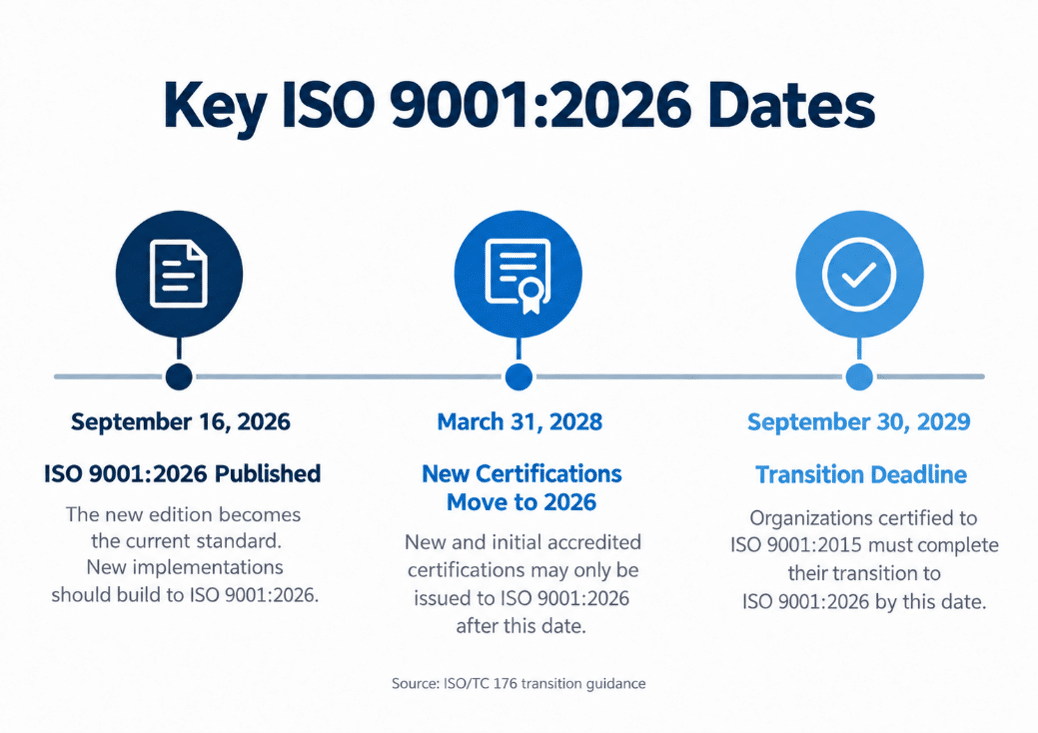
Key ISO 9001:2026 Dates
- September 16, 2026: ISO 9001:2026 is published and becomes the current version of the standard.
- March 31, 2028: All new and initial accredited certifications must be issued to ISO 9001:2026.
- September 30, 2029: Organizations certified to ISO 9001:2015 must complete their transition to ISO 9001:2026.
What Changed in ISO 9001:2026?
ISO 9001:2026 keeps the familiar structure of ISO 9001:2015, but strengthens several areas that affect how organizations lead, plan, manage risk, and engage their people.
| Focus Area | Where to Look | 2015 Approach | What’s Changing in 2026 | What It Means | What You May Need to Do |
| Leadership | 5.1 | Leadership accountability for the QMS | More emphasis: quality culture and ethical behavior | Leaders may need to demonstrate more visible involvement in quality. | Review quality in regular leadership meetings, assign ownership of objectives, and reinforce how quality concerns are raised and addressed. |
| Strategic Alignment | 5.2 | QMS aligned with organizational context and strategic direction | Stronger connection: quality policy, QMS, and business strategy | Quality planning should more clearly support business priorities. | Review whether quality objectives and processes support growth plans, new markets, customer needs, and other strategic priorities. |
| Risks & Opportunities | 6.1 | Risk-based thinking | Clarified: risks and opportunities receive distinct attention | Organizations should consider both threats to results and opportunities to improve them. | Review planning methods to ensure opportunities are identified and acted on, not only risks. |
| People & Quality Culture | 7.3 | Awareness of the quality policy and individual contribution | More emphasis: culture, ethics, and employee contribution | Employees may be expected to show a clearer understanding of their role in quality. | Strengthen onboarding, training, quality communications, lessons learned, and methods for raising concerns. |
| Guidance | Annex A | Guidance primarily within clauses and notes | New guidance: additional clarification on intent and terminology | Organizations will have more context for interpreting requirements. | Use Annex A when reviewing requirements before adding new documentation or processes. |
Your Organization’s ISO 9001 Next Steps
ISO 9001:2026 creates two different paths depending on whether your organization is implementing ISO 9001 for the first time or already certified under ISO 9001:2015.
Implementing ISO 9001 for the First Time
If your organization is starting a new ISO 9001 implementation, build your QMS around ISO 9001:2026.
Starting with the current standard allows you to avoid designing a system around older requirements and then updating it later.
Step 1: Define Your Goals and Scope
Determine why your organization is pursuing ISO 9001 and what parts of the business will be included.
Consider:
- Products and services
- Locations
- Customer requirements
- Contract requirements
- Regulatory requirements
- Business objectives
Step 2: Assess What You Already Have
Most organizations already have processes that support ISO 9001 requirements.
These may include:
- Policies and procedures
- Employee training
- Supplier management
- Customer feedback
- Performance metrics
- Corrective actions
- Quality checks
A gap analysis helps determine what already meets the standard and what still needs to be built or improved.
Step 3: Build or Strengthen the QMS
Develop the processes needed to meet ISO 9001:2026.
This may include:
- QMS scope
- Quality policy
- Quality objectives
- Roles and responsibilities
- Risk and opportunity management
- Document control
- Supplier management
- Operational controls
- Competency and awareness
- Performance measurement
- Corrective action
- Internal audits
- Management review
The goal is to build a system that fits the business rather than adding unnecessary processes solely for certification.
Step 4: Put the System into Practice
Employees need to understand and use the processes that affect their work.
Organizations also need evidence that the QMS is operating consistently.
Step 5: Conduct an Internal Audit and Management Review
Before certification, evaluate whether the system is working as intended.
Use the results to identify gaps and corrective actions.
Step 6: Prepare for Certification
Select an accredited certification body and prepare for the certification process.
Where Alluvionic Can Help
Alluvionic can support organizations from initial gap analysis through implementation and certification preparation.
Support can include:
- Gap assessments
- QMS development
- Process documentation
- Internal audit preparation
- Employee training
- Management review preparation
- Certification readiness
Already ISO 9001:2015 Certified
Organizations certified to ISO 9001:2015 should assess gaps early and make targeted updates to their existing QMS before the 2029 deadline.
Step 1: Understand the Changes
Review the revised requirements and determine which changes are relevant to your organization.
Focus on:
- Leadership
- Quality culture
- Ethical behavior
- Strategic alignment
- Risks and opportunities
- Employee awareness
Step 2: Complete a Gap Analysis
Compare your existing QMS against ISO 9001:2026.
For each requirement, ask:
- Do we already meet this requirement?
- Do we meet it but lack clear evidence?
- Does an existing process need to change?
- Is a new process or activity needed?
This helps separate meaningful changes from areas where your current system is already sufficient.
Step 3: Update the QMS
Make targeted changes where needed.
This could include updates to:
- Policies
- Procedures
- Responsibilities
- Training
- Risk and opportunity processes
- Management review
- Quality objectives
- Internal audit criteria
The transition can also be used as an opportunity to simplify processes that have become overly complex.
Step 4: Engage Leaders and Employees
Make sure leaders, managers, and employees understand the changes that affect their roles.
Training should be appropriate to each person’s responsibilities.
Step 5: Plan the Transition Audit
Work with your certification body to determine when your transition will occur.
The transition may happen during:
- A surveillance audit
- A recertification audit
- A separate transition audit
Where Alluvionic Can Help
Alluvionic can review your current QMS, identify gaps, and build a prioritized transition plan.
This helps organizations focus effort where changes are actually needed.
Frequently Asked Questions
If You Are Implementing ISO 9001 for the First Time
Should we implement ISO 9001:2015 or ISO 9001:2026?
Organizations starting a new implementation should build around ISO 9001:2026.
It is the current edition and will be the basis for new certifications moving forward.
Do we have to start from scratch?
Usually not.
Most organizations already have processes that can support ISO 9001 requirements. A gap analysis helps identify what can be used, what should be improved, and what is missing.
How much documentation do we need?
ISO 9001 does not require documentation for every activity.
The amount of documented information should fit the organization’s size, complexity, processes, and risks.
How long does implementation take?
Implementation timelines vary based on:
- Organization size
- Number of locations
- Process complexity
- Existing documentation
- Internal resources
- Current level of process maturity
A gap analysis is typically the best way to establish a realistic implementation plan.
Do we need a consultant?
No, but outside support can help organizations interpret requirements, avoid unnecessary work, and keep implementation moving.
If You Are Already ISO 9001:2015 Certified
Do we need to rewrite our entire QMS?
Generally, no.
Most organizations should be able to make targeted updates to their existing system.
When do we need to transition?
Organizations certified to ISO 9001:2015 must complete the transition by September 30, 2029.
Can we transition during our regular audit?
Yes.
The transition may be completed during a surveillance audit, recertification audit, or separate transition audit.
Should we wait until 2029?
The transition period provides flexibility, but organizations can begin preparing now.
Starting with a gap analysis gives you time to address changes through normal QMS activities instead of handling them all at once near the deadline.
Will employees need training?
Some level of awareness or training may be appropriate, particularly around revised expectations related to leadership, quality culture, ethical behavior, risks, and opportunities.
The level of training should depend on each person’s role.
Build a QMS That Supports the Business
A well-designed quality management system can help standardize processes, improve accountability, strengthen decision-making, manage risks and opportunities, and support continual improvement.
Alluvionic helps organizations implement, improve, and transition ISO 9001 quality management systems with practical support tailored to how the organization operates.
Talk to Alluvionic about your ISO 9001:2026 path.