 SEWP VI awardees have already done the hard work of winning a spot on NASA SEWP VI. But for some awardees, staying eligible to compete for task orders requires finishing additional compliance work after award.
If your company was awarded a SEWP VI contract while your ISO 9001 or CMMI certification was still in process, you may be working against a 12-month deadline. And every SEWP VI contract holder, regardless of category and business size, must submit either the C-SCRM Attestation Form or an ISO 20243 certificate.
Winning the vehicle does not guarantee continued access to new work. A missed post-award requirement could leave your company unable to compete for new SEWP VI opportunities.
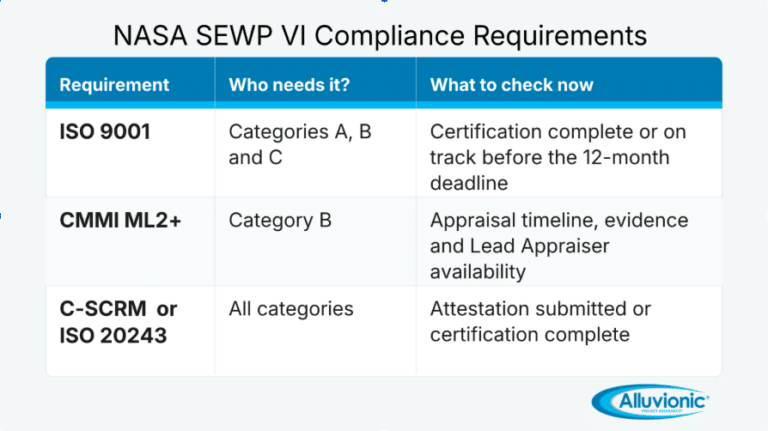
Here are the three requirements to check now.
1. ISO 9001
Who needs it?
Categories A, B and C.
NASA requires SEWP VI contractors across all three categories to hold ISO 9001 certification.
 Some businesses were allowed to receive an award while certification was still in process. Those contract holders have 12 months from contract award to complete it.
For companies awarded in July 2026, that puts the deadline around July 2027.
If the certification is still not obtained after 12 months, the contractor may be subject to off-ramping.
How long does ISO 9001 usually take?
A typical implementation may take:
- 3–6 months for smaller organizations
- 6–12 months for mid-sized or more complex organizations
The timeline depends on how mature the organization’s existing quality processes are.
The work commonly includes:
- documenting the Quality Management System
- implementing required processes
- training employees
- performing internal audits
- completing management review
- correcting issues
- completing the external certification audit
The important point: your deadline is the date certification needs to be complete, not the date to start preparing.
What can ISO 9001 cost?
Costs vary by company size, scope and complexity, but common planning ranges include:
- Certification audit: about $5,000–$15,000
- Annual surveillance audits: about $2,000–$5,000
- Recertification: about $3,000–$7,000 every three years
Internal labor, consulting and implementation costs may be additional.
What tends to cause delays?
Common issues include:
- treating ISO as a documentation exercise
- underestimating the internal work required
- waiting too long to conduct internal audits
- discovering process gaps too close to the external audit
- failing to train employees on the processes they are expected to follow
ISO 9001 is also going through a transition. ISO 9001:2026 was published in September 2026 and is now the current version of the international standard. SEWP VI’s contractual requirements, however, reference ISO 9001:2015. Contractors pursuing a new certification should confirm their certification path with their registrar and, if needed, the SEWP Program Management Office as the industry moves through the transition.
Read more: ISO 9001:2026 Guide: What Changed, How to Implement, and How to Transition
2. CMMI Maturity Level 2 or Higher
Who needs it?
Category B only.
Category B contractors must have either:
- CMMI Development, or
- CMMI Services
 at Maturity Level 2 or higher.
Categories A and C do not have a CMMI requirement.
If a Category B contract holder was awarded a SEWP VI contract while its appraisal was still in process, the same 12-month post-award window applies.
What usually takes the most time?
CMMI extends far beyond writing policies. Organizations are appraised on whether processes are established, consistently followed and supported by evidence.
Preparation commonly includes:
- reviewing current processes
- identifying gaps
- updating procedures
- training employees
- showing that processes are being followed
- collecting objective evidence
- preparing for the formal appraisal
One of the biggest timing risks is evidence.
A procedure can be written quickly. Demonstrating that teams have consistently used it over time can take much longer.
That is why Category B holders should look closely at their appraisal timeline, evidence readiness and Lead Appraiser availability well before the 12-month deadline.
What does CMMI cost?
There is no single flat cost because the total investment depends on:
- organization size
- appraisal scope
- current process maturity
- remediation work
- training needs
- appraisal-team requirements
- Lead Appraiser fees
- internal employee time
The best early indicator is usually a readiness or gap assessment that shows how much work remains before appraisal.
3. Supply Chain Security: C-SCRM Attestation Form or ISO 20243 Certificate
Who needs it?
All SEWP VI contract holders, regardless of category and business size. Each must submit one of the following: the Cybersecurity Supply Chain Risk Management (C-SCRM) Attestation Form or an ISO 20243 certificate.
Option 1: Submit the C-SCRM Attestation Form. Contract holders taking this route must maintain a C-SCRM Plan that describes how supply chain risks are identified, evaluated and managed. NASA requires:
- an initial C-SCRM Plan within 60 calendar days of contract award as part of the onboarding process
- ongoing maintenance
- annual updates
Option 2: Submit an ISO 20243 certificate instead. Contractors who hold ISO 20243 certification may submit it in place of the C-SCRM Attestation Form. In that case, either the O-TTPS Self-Assessed Certification or the O-TTPS Third-Party Assessed Certification can be submitted.
If you chose Option 1, check:
- Who owns the annual C-SCRM Plan update?
- Are supplier risks being reviewed consistently?
- Is there evidence supporting the practices described in the C-SCRM Plan?
C-SCRM responsibilities often sit across cybersecurity, contracts, procurement and operations. If ownership is unclear, annual maintenance can easily fall through the cracks. If you chose Option 2, confirm which O-TTPS certification you submitted and that it is on file.
What Happens If a Required Certification Is Missing?
A contract holder that has not completed a required qualification may be ineligible to compete for acquisitions requiring it.
If a certification that was still in process at award is not completed within the required 12-month period, the contractor may also be off-ramped from SEWP VI.
Contractors with open orders may be placed in “Dormant” status long enough to finish those orders before being removed from the vehicle.
A company can invest substantial time and resources winning a place on SEWP VI, then lose access to future opportunities if the post-award requirements are not completed.
Confirm SEWP VI Compliance Status and Next Steps
SEWP VI holders should confirm the following details to determine which requirements apply, what work remains and when it must be completed:
- Your exact SEWP VI contract award date.
- Which category or categories you hold.
- Whether ISO 9001 and, if applicable, CMMI were complete at award.
- Who owns the next annual update for your C-SCRM Plan, if you did not submit an ISO 20243 certificate.
If any of those answers are unclear, that is the issue to resolve first.
For SEWP VI holders with outstanding requirements, the priority is to turn compliance gaps into an actionable plan—with clear ownership, realistic milestones and evidence of progress. Addressing that work early can help keep certification and appraisal efforts aligned with post-award deadlines.
Ready to plan the next step?
Explore Alluvionic’s ISO 9001 support or CMMI support to consider a path forward for the organization’s certification or appraisal needs.